
Vehicle access
Automatic Road Barriers
Parking and boom barriers that stop casual entry, make every driver identify themselves and record who came and went.
- Standard
- High-speed
- Fence boom
- Folding arm
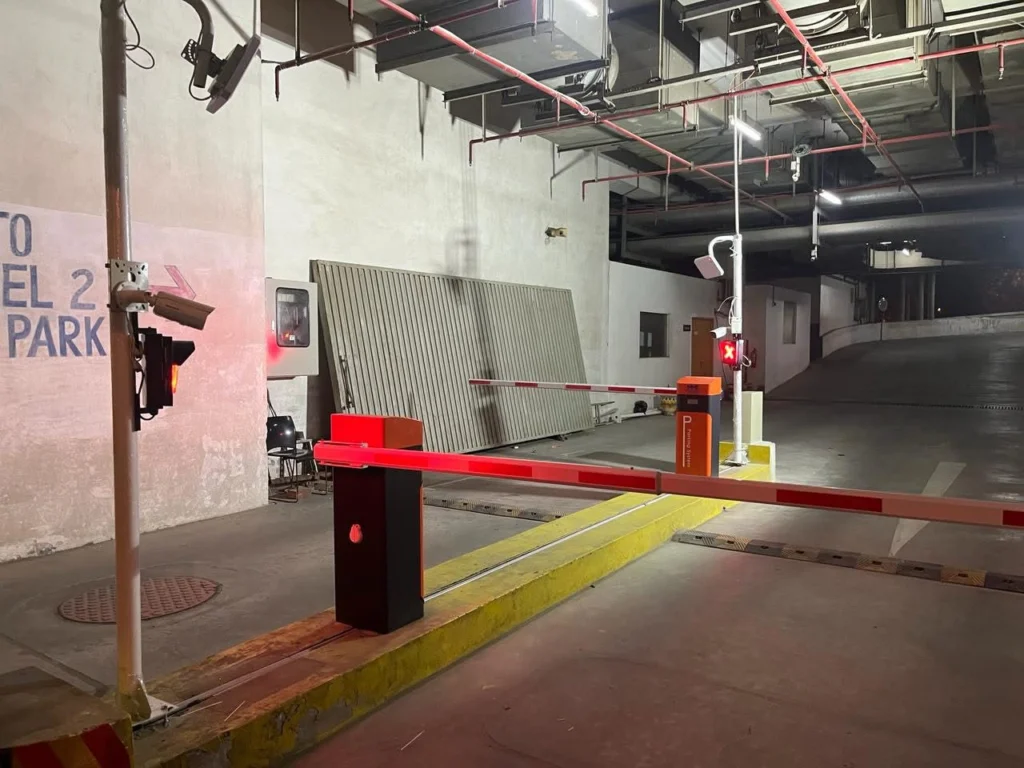
- Boom length and speed matched to your lane and traffic
- Opens by guard button, remote, RFID / E-Tag, ticket or number plate
- Safety loops stop the arm dropping on a vehicle
Types
Which barrier suits your gate?
Boom length must cover the lane; opening speed must match the traffic.
Best forSocieties, offices, small car parks, factory gates
Best forPlazas, malls, hospitals and toll lanes
Best forSites that need a visual deterrent too
Best forBasements and gates with low headroom
Opening methods
How drivers open the barrier
Most sites combine two — tags for regular vehicles, tickets or guard control for visitors.
Registered vehicles pass without stopping
Paid parking, fee calculated at exit
The camera reads the plate and opens the lane
Guards, residents and approved visitors
Specifications
At a glance
- Types
- Straight, articulated, fence-boom, folding-arm
- Safety
- Loop detectors, photocell beams, auto-reverse
- Control
- Button, remote, RFID, ANPR, ticket dispenser, software
Model specifications are confirmed with your quotation after the site survey.
Applications
Where it’s used
Works with
Part of a connected system
In depth
Technical information
Detailed guidance on automatic road barriers from our survey and installation team.
Which barrier suits your gate?
The single most important number is the boom length, which must cover the full lane width, and the second is opening speed, which must match your traffic volume. Buying a slow barrier for a busy plaza creates queues; buying a fast one for a quiet society wastes money.
Specifications we supply
- Safety: loop detectors to prevent the arm dropping on a vehicle, plus photocell beams and auto-reverse
- Housing: powder-coated steel or stainless steel, with LED boom lighting on request
- Control: push button, remote control, RFID, number-plate recognition, ticket dispenser or software command
Brands we commonly supply include Centurion, Powertech and equivalent industrial-grade units, chosen for the traffic volume rather than the price tag alone.
How drivers open the barrier
- Guard push button — simplest, but every opening depends on a person
- Remote control — suits a fixed set of residents or staff vehicles
- Long-range RFID / E-Tag — a windscreen tag is read from several metres, so registered vehicles never stop
- Ticket dispenser and barcode — for paid public parking, with the fee calculated at exit
- ANPR camera — the camera reads the number plate and opens the lane automatically
- Mobile app or QR — residents and approved visitors open the gate from a phone
Most sites combine two: tags for regular vehicles and tickets or guard control for visitors. All of these can be driven by our parking management system, which records every entry with a photograph.
Where we install road barriers
- Housing societies and gated communities
- Commercial plazas, shopping malls and hospitals
- Corporate offices and industrial units
- Universities, colleges and schools
- Warehouses, dry ports and logistics yards
- Banks, government buildings and army installations
Installation, step by step
- Site survey — lane width measured, traffic counted, power and cable routes identified.
- Foundation — concrete base cast with anchor bolts and conduit for the loop and control cables.
- Loop cutting — safety and exit loops cut into the road surface and sealed.
- Installation — barrier set and levelled, boom fitted and balanced, wiring terminated.
- Support — spring tension checks, spares and call-out service under a maintenance contract.
What decides the price
- Boom length and whether the arm is straight, folding or fence type
- Control method: guard button only, or RFID, ANPR and software
- Civil work, loop cutting and the condition of the existing road
- Number of lanes and whether entry and exit are separate
Because these vary so widely, we quote after a survey rather than over the phone. A single-lane society gate and a four-lane plaza are different projects.
FAQ
Common questions
Can the arm hit a vehicle?
Not when the safety loop is installed correctly. The loop detects metal under the boom and holds the arm up until the vehicle has cleared. We fit loop detectors as standard rather than as an optional extra.
How long does installation take?
For one lane, the foundation needs one day plus curing time, then half a day for installation and testing. Loop cutting adds a few hours. Multi-lane sites are phased so at least one lane stays open.
Do you sell to dealers and contractors?
Yes, on trade terms with stock availability and technical support. See wholesale and dealer supply.

Next step
Tell us about your gate
Lane width, traffic and how drivers should open it — we survey, then quote.
Prefer to talk? +92 42 35786020 · WhatsApp